Discover the Talks at PyCon Colombia 2026 ✨
Browse every accepted session—titles, tracks, levels, and speakers—before you plan your days in Medellín.
Building AI Agents to Play Catan
Designing AI for environments with chance and imperfect information is a fascinating challenge. In this workshop, we will develop a Python agent capable of playing Settlers of Catan and compare different approaches live. Beyond the board, attendees will discover how the principles used here apply to any LLM-based agent system. You will learn to equip your agents with tools, connect services via MCP (Model Context Protocol), and structure robust architectures to optimize complex decision-making.

Machine Learning Applied to Genetic Sequences
DNA contains massive amounts of biological information, but how can artificial intelligence help us understand it? In this talk, we will explore how Python and Machine Learning can be used to analyze genetic sequences in a practical and beginner-friendly way. Using public biological datasets, we will demonstrate how DNA sequences can be transformed into data suitable for machine learning models, covering concepts such as feature extraction, sequence representation, and basic classification techniques. We will also review popular Python tools used in bioinformatics, including Biopython, pandas, and scikit-learn, while discussing real-world challenges when working with biological data, such as high dimensionality, noise, and interpretability limitations. By the end of the talk, attendees will have a clear understanding of how to start building genetic analysis projects using accessible tools from the Python ecosystem, even without prior bioinformatics experience.

From Voice to Action: Building an AI Assistant with Python and Google Workspace
Jumping between Gmail, Calendar, Drive, and Jira tabs for repetitive tasks is exhausting. That's why we built Attento, an assistant that lets you execute real actions in Google Workspace using natural language. In this talk we build Attento, an end-to-end voice assistant that turns natural language into real actions across Google Workspace. We'll cover architecture with FastAPI, OAuth 2.0 authentication with PKCE, function calling with Gemini, streaming with NDJSON, best practices with uv and Pydantic Settings, and the path from demo to production with Postgres and automated morning briefings.

Juan Manuel Marín Bedoya
Senior Data Engineer @ Huge

Juliana Suárez Ávila
Data Scientist @ Cuesta Partners
How to Find Pearls on the Bottom of the Sea - Autoencoders as Anomaly Detection Model
In the AI/Machine Learning world, we often think of anomalies as errors that need to be fixed. But what if some of those anomalies are actually opportunities of immense value? Detecting these opportunities, these "pearls," is a huge challenge due to the vastness and complexity of the data ocean. There is a solution: anomaly detection models—positive ones in this case—and we will explore them in this session.

Not Every Nail Needs an AI Hammer: Architectures That Think Before They Generate
We live in an era where everything "needs generative AI"... or so we're told. In this talk I'll cut through the hype to talk about what really matters: designing clean, intentional, and sustainable architectures. We'll explore how to combine the best of the traditional world with emerging tools without falling into over-engineering. Because sometimes a well-placed regex beats a multi-million-parameter LLM. If you're tired of seeing Ferraris parked at the supermarket, this talk is for you.

The GenAI Revolution Reaches RecSys
When we talk about the generative AI revolution, the conversation usually stays close to chatbots, image generation, and code assistants. But the same architectures that powered that wave (transformers, autoregressive modeling, scaling laws) are quietly reshaping fields most people don't associate with GenAI at all. Recommender systems are one of the most interesting examples. Meta, Netflix, Google, Spotify and others are replacing decades-old recsys pipelines with transformer-based foundation models, and the results are hard to ignore. This talk is a practical tour of that shift from a Python engineer's seat.

Feeding the Invisible: Food Security in Intermediate Cities with Python
In many countries, food insecurity is not only a social problem but also a data problem. In Colombia, key monitoring systems have lost continuity, leaving critical information gaps for public decision-making. This talk presents the development of a Python prototype to build a monitoring and prediction system for food insecurity risk in intermediate cities, using only open data. From a reproducible pipeline, multiple data science components are integrated: ingestion and processing of food price data (SIPSA), time series models for price forecasting (including classical approaches and machine learning like XGBoost), household segmentation through clustering from socioeconomic surveys, construction of a composite index relating income, prices, and vulnerability, and development of a decision support system (DSS) prototype. Attendees will take away a replicable approach for building complex indicators, strategies for working with imperfect open data, ideas for integrating models, socioeconomic data, and visualization in a single system, and a real example of applying Python in public policy and territorial development.

Opening the Black Box: Mechanistic Interpretability of LLMs
As agents are deployed in high-stakes contexts (finance, manufacturing, healthcare), understanding how they make decisions—and not just what they decide—becomes fundamental to safety and trust. For example, when an agent receives the instruction "Search for our company's third-quarter results" and chooses to search internal documents instead of the public web, what internal process drives that choice? Answer engineering, behavioral testing, and chain-of-thought analysis describe correlations or narratives; none reveals the actual mechanism. Understanding how an agent reaches a conclusion is a critical component of developing AI responsibly, especially regarding reliability and transparency in AI systems. Model interpretability is one way developers can build trust and consistency in their systems and support the safe deployment of AI agents.

The Fellowship of Agentic Evaluations: How to evaluate an agent?
Autonomous agents are redefining what we can build with LLMs, allowing AI not only to respond but to reason and execute actions across complex flows. However, as we give them more autonomy with tools like LangGraph, a critical engineering problem arises: How do we know if the agent is truly reliable? In this workshop, we will address the challenge of agent evaluation. We do not want to limit ourselves to checking whether the final response sounds good, but to implement different ways of evaluating these agents, ranging from deterministic validations to metrics based on other LLMs (LLM-as-a-judge). For this exercise, we will apply these concepts to the universe of The Lord of the Rings mixed with real medical standards to validate mainly: - Data Integrity: Validate that the agent correctly extracts and formats structured medical codes. - Fidelity: evaluate that the agent does not hallucinate diagnoses. - Observability: Trace and cost monitoring with Langfuse. Upon completion, attendees will have a clear idea of how to answer the question: How to evaluate an agent?

Maria Fernanda Rojas Castro
Advanced Data Engineer @ Loka INC

Nicolas Roldan Fajardo
Advanced Machine Learning Engineer @ Loka INC
hls4ml: From Python Models to Hardware Acceleration
This session presents a journey from developing machine learning models in Python to their implementation in hardware through the hls4ml tool. The goal is to show how models built in widely used frameworks such as TensorFlow, Keras, or PyTorch can be transformed into efficient hardware descriptions for deployment on reconfigurable devices. The complete workflow will be covered, including model preparation, conversion to High Level Synthesis (HLS) code, and the main hardware optimization criteria such as quantization and precision reduction. The trade-offs between latency, energy consumption, and model accuracy will also be discussed.

Jeronimo Lopez Gomez
Estudiante, Joven Investigador @ Universidad de Antioquia, Grupo de Instrumentacion Cientifica y Microelectronica

Natalia Echeverri Durán
Estudiante @ Universidad de Antioquia, Grupo de Instrumentacion Cientifica y Microelectronica
Building a Transformer with Rust
Transformers are often perceived as incomprehensible giants. This talk aims to prove the opposite: they are not black boxes but elegant mechanisms that can be understood and mastered from their fundamentals. We present Molinete AI, a GPT-2-style model built strictly from scratch in Rust. No deep learning frameworks—just tensors, math, and full control. Inspired by Feste from Tag1 Consulting (trained on Shakespeare), this project poses a different challenge: training the network on Miguel de Cervantes's work to generate text in the style of the Golden Age. Throughout the session we'll break the model down piece by piece. With the support of a Manim animated presentation (over 4,000 lines of code), we'll make visible how information flows inside the network. We'll start from tokenization (BPE) and building basic operations, then dive into the core of the model: embeddings, causal mask, and Multi-Head Self-Attention. Finally, we'll explore the learning process, watching how gradients flow through the network during training. More than a demo, this talk aims to provide a clear, operational view of Transformers, connecting theory with a real from-scratch implementation.

NLP Without Labels: How to Cluster N Legal Processes of the Colombian State and Turn Chaos into a Production Classifier
What do you do when you have 600,000 legal complaints, zero labeled data, and a government entity waiting for results? This talk walks through the full process of building an unsupervised NLP classification system for the Procuraduría General de la Nación. Starting from raw administrative text—noisy, full of abbreviations and institutional jargon—I'll show how TF-IDF, truncated SVD, and KMeans combined to organize more than half a million records into 64 semantically coherent groups, without a single manual label. But clustering is only the starting point. I'll cover how clusters were validated, how a Logistic Regression classifier was trained on them to make the system deployable, and how the final pipeline was packaged in a .pkl that non-technical colleagues use in production today. Along the way we'll face real problems: elbow curves that don't behave, 1:20 size imbalances between clusters, and the tension between mathematical elegance and institutional usability. Because in the public sector, a model nobody uses isn't a model—it's a PDF gathering dust.
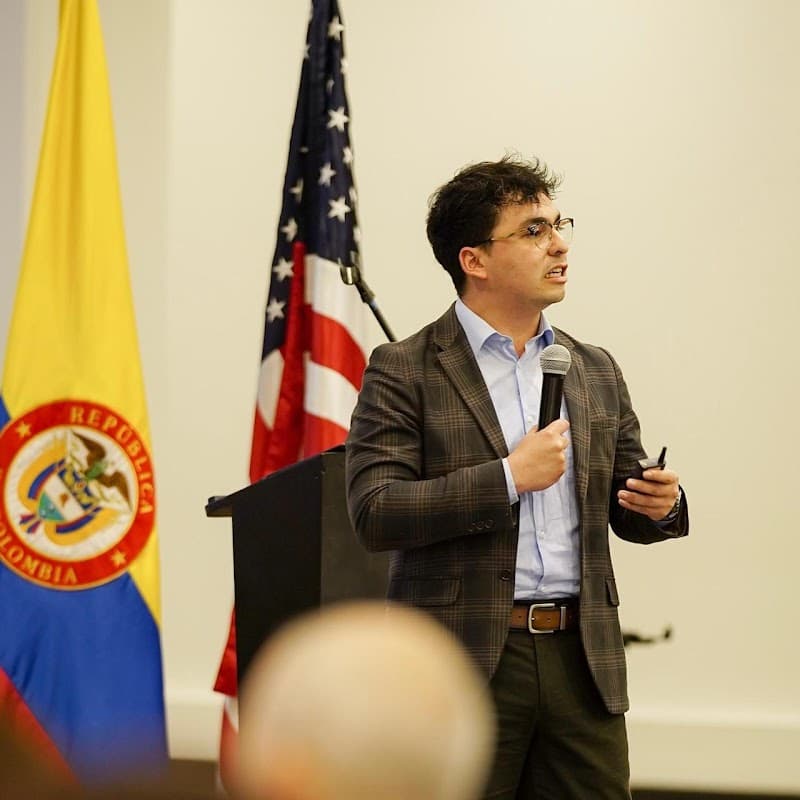
From Expert Judgment to Autonomous Optimization: Encoding Human Expertise into LLM Judges with DSPy
A single misread clause in a reinsurance contract can mean millions in liability. Our LLM pipeline could extract and summarize these documents, but how do you know the output is actually correct? String matching fails ("USD 5,000,000" vs "$5M" scores zero), human review at scale is unaffordable, and a single LLM-as-judge prompt gives inconsistent, uncalibrated scores. The real bottleneck was never generation; it was evaluation. This talk shows how we solved it in two steps, both built entirely in Python. First, we encoded expert evaluation at scale. We collected structured reviews from five domain experts across different insurance areas, then used DSPy to distill their judgments into a panel of calibrated LLM judges, each targeting a single quality dimension (factual accuracy, task alignment, faithfulness, technical depth, clarity), weighted to reflect what experts actually care about. On our validation set, the panel's per dimension scores stayed within 10% of expert consensus across every dimension, with the same relative shape close enough to trust as a fitness function, not just a diagnostic. Expert disagreement turned out to be our most powerful debugging tool: where reviewers diverged, our definitions were ambiguous; where they agreed, we had ground truth. Then we closed the loop. Using DSPy's MIPROv2 and GEPA optimizers, we wired the judge panel as a fitness function and let the system rewrite prompts autonomously. Regression guards prevent gaming across dimensions. Humans review only the final score delta and diff through a CI gate, and experts shifted from repetitive review to refining the evaluation rubric itself, which is something only they can do. The stack is Python-native: DSPy, MLflow, LiteLLM, Pydantic. Every code snippet is production code, not pseudocode. You will leave with a concrete recipe for encoding expert knowledge into automated LLM evaluation and self-improving optimization, applicable to any domain where "correct" is nuanced: legal review, medical summaries, code review, customer support, or your own pipeline.

Mateo Rios Querubin
Senior ML Engineer @ Provectus / Universidad EAFIT

Sebastián Gómez Ahumada
Middle ML Engineer @ Provectus
LLMs in Depth: How an LLM Works Mathematically (and Its Implementation with PyTorch)
Imagine a 30-minute space where mathematics, code, thought experiments, and one of the most attractive topics of the present converge during powerful minutes — that is what this presentation seeks. The goal of this talk is to review each of the components of a Large Language Model (LLM), from the embedding system and the BPE algorithm to the attention mechanism that is the core of modern AI, passing through normalization and the small "tricks" used in both training and inference to improve results and make LLMs more optimal. Each of these components will be addressed from three perspectives: 1) the pure mathematics that composes the solution, 2) the interpretation of this mathematics (why it is useful and how we can visualize it), and 3) the implementation in code, where small code snippets will show how these systems are implemented in Python. At the end, an open-source code repository will be provided with the full implementation and training pipeline for a "playground model" implementing a GPT-style model. The intention with this talk is not only to shed light on one of the most interesting and complex topics in the modern world, but also to provide tools to question how these systems work and promote research in this field.

From Notebook to Production: End-to-End MLOps on Databricks
Is your Machine Learning model trapped in a Notebook or does it actually generate value in production? Taking ML models into the real world requires more than just good training code; it demands a solid MLOps strategy. In this hands-on workshop, we will transform a use case from scratch into an industrial-grade solution using Databricks and MLflow. Through a hands-on approach and using Databricks Free Edition, attendees will master the complete lifecycle (End-to-End) under professional standards. Workshop Agenda: - Industrialization Fundamentals: Introduction to Lakehouse architecture, MLflow as an industry standard, and the role of the Feature Store in reproducibility. - Engineering and Governance: Creating a Feature Store and managing raw data with best practices. - Scalable Training: Developing models with exhaustive experiment tracking and a bonus on distributed training for large data volumes. - Deployment Strategies: Analysis of trade-offs between Batch Inferencing and Real-time Serving (Model Serving). We will implement "Deploy Code" and "Deploy Artifacts" patterns. - Modern Operationalization: Professional orchestration through Databricks Asset Bundles (DABs), the definitive tool for infrastructure as code on Databricks. - The finishing touch (CI/CD): How to integrate everything into a continuous deployment pipeline to guarantee quality across multiple environments. Outcome for attendees: Upon completion, each participant will have the source code, infrastructure configuration, and a productized, orchestrated ML model ready to be replicated in real environments.

Fine-tuning at Nequi: Teaching a Small Model the Language of Our Transactions
At Nequi, a transaction is not just an amount and a date — it is behavior, context, and sequence. Generalist models do not capture that semantics, and rigid rules do not scale with millions of users. In this workshop we explore hands-on how to fine-tune a small model so it learns the language of transactional events: their patterns, anomalies, and risk signals. Participants will work from dataset construction to model validation, understanding at each step which decisions matter and why

Angie Katherine Reyes
AI Builder & Team Lead @ Nequi

Elkin Javier Guerra Galeano
Machine Learning Engineer | MLOps @ Nequi
Real-Time Voice Systems: Design and Architecture in 5 Levels
Voice systems have advanced rapidly in recent years, but most implementations still stop at demos: simple combinations of Speech-to-Text, language models, and Text-to-Speech that work in controlled environments but fail when facing real-world conditions. This talk proposes a different approach: understanding voice systems as an architecture that evolves through maturity levels, from basic prototypes to real-time production-ready systems. Through a 5-level framework, we'll walk the full path of a Conversational AI system: from integrating basic components, through orchestration challenges (streaming, latency, turn-taking), to less obvious but critical problems like audio quality, robustness, and user experience, reaching real-time architectures with technologies like LiveKit, and finally exploring where the future is headed with end-to-end systems and multimodal agents. The talk is based on real experience building voice systems in production and focuses on engineering decisions more than specific tools. Attendees will leave with a clear understanding of how to design modern voice systems with Python, what problems to anticipate, and how to structure their own architectures to build world-class conversational experiences.

Python and Machine Learning for Sustainable Thermochemical Optimization
Chemical engineering still relies heavily on costly, slow experimental trials to evaluate operating conditions in thermochemical processes. This talk proposes a practical approach based on Python and machine learning to accelerate that process: building predictive models from physicochemical data that estimate key outcomes without testing every scenario in the lab. A complete flow oriented toward real applications will be shown, from data to decisions, with the goal of reducing analysis time, lowering experimental costs, and supporting process optimization with environmental impact.

Clean Code in the Era of LLMs: Do Good Practices Still Matter?
Instead, research from METR, CodeRabbit, and GitClear is converging on an uncomfortable truth: code duplication has quadrupled, copy-pasted code now exceeds moved code, bugs have risen 70%, and security issues have nearly tripled. AI didn't break our codebases. It amplified what was already broken. So what do we actually do about it? Do decades of hard-won engineering wisdom still apply when a model writes half the code, or do we need a new playbook entirely? Are clean code, SOLID, DDD, TDD, and the design patterns we've spent decades arguing about dead weight in the age of Claude Code and Copilot, or do they matter more than ever? This talk makes the case for the second answer. Your codebase is now a prompt: clean code leads to better AI suggestions, which make it easier to stay clean. Messy code leads to worse suggestions, which make it harder to recover. We'll walk through which practices now matter more (SOLID, DDD, TDD), which ones have quietly turned against you (hello, aggressive DRY and Abstract Factories), and how to collaborate with an LLM without becoming a rubber stamp for its output. You'll leave with a concrete framework, Adversarial Collaboration, that you can apply the next morning: generate, critique, refactor, verify. Not vibe coding. Not perfectionist prompting. Real engineering, just faster.

PDF Data Extraction at Scale: When to Trust an LLM
LLMs read chaotic documents like no one else, but when money or legal liability is on the line, the question is not "can it?" but "when should I trust it, and how do I catch it when it is wrong?". In this hands-on workshop we build, step by step, a real extraction pipeline for legal PDFs with variable formats, orchestrated with Airflow, using a hybrid extractor (deterministic + LLM) and deterministic guardrails in Python. You will leave with a framework for deciding which tool to use and a reliable pattern for production environments.

Your AI Eval Is Lying To You
When you set temperature=0 and run your AI eval, you expect the same input to give the same output. It doesn't. Recent measurements on Qwen3-235B at temperature=0 produced 80 unique completions on a single prompt. So when your eval reports "92% pass rate," what does that actually mean? Is it 92% capable, 92% reliable, or 92% lucky on a small sample? This talk is about the gap between how the AI eval ecosystem talks about scores and what those scores can actually support. We walk through five specific tools that fix the gap, all anchored to published methods: 1. Pass@k versus pass^k: capability versus reliability, two different questions that one number obscures (Chen et al. 2021, OpenAI Codex paper). 2. Wilson confidence intervals with proper boundary handling, so your "92%" comes with an honest range (Brown et al. 2001). 3. Bayesian pass@k with Beta-Binomial conjugacy, when you want a posterior rather than a point estimate (Hariri et al., ICLR 2026). 4. Sequential drift detection with EWMA, CUSUM, and OLS, to catch eval regression while it's small instead of after a customer reports it (Lucas-Saccucci 1990, Page 1954, Montgomery 2012). 5. Family-wise error control via Benjamini-Hochberg, Benjamini-Yekutieli, and e-BH FDR procedures, for when you're running multiple correlated drift checks in parallel and don't want false alarms (Benjamini-Hochberg 1995, Wang-Ramdas 2022). Each method gets a short demo in pure Python with no framework dependency. The audience leaves with reference implementations they can paste into an existing pytest setup tonight. The talk also previews an open-core pytest plugin shipping in July 2026 that packages these methods into a single eval pipeline with SARIF reporting and a baseline-regression workflow. The talk shows the open primitives and the methodology that drives them. The production AI-eval ecosystem (LangSmith, Arize Phoenix, Evidently, DeepEval, Promptfoo, and others) mostly uses absolute thresholds and simple averages. None of the ten platforms I surveyed combine sequential testing with FDR control on bounded scoring scales. The framing here isn't competitive; it's a methodological gap every team shipping production AI evals will hit eventually.